
 EN
 DE
 FR
French Provencal Beef Stew (Daube)


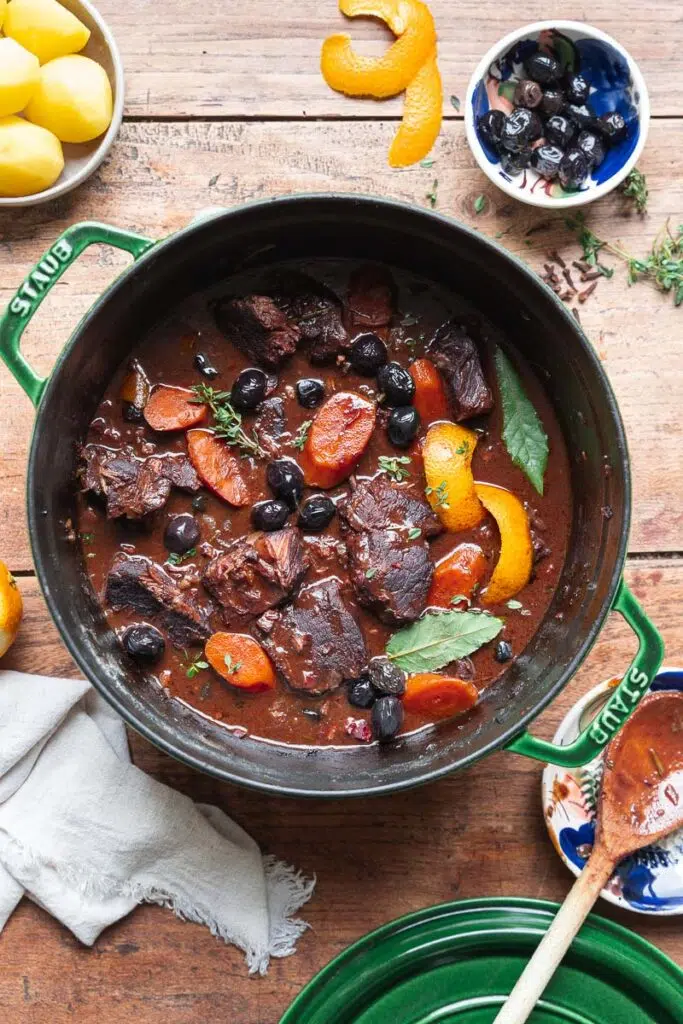
Provençal daube is one of those dishes I love to make when I have guests over—just like every braise you can make ahead, and it tastes even better the next day.
Jump to
If you’ve never heard of Daube, think of it as the southern cousin of Beef Bourguignon: a French beef stew where the meat is braised in red wine with orange peel, cloves and black olives.
You’ll see, this daube recipe is really easy. You just need to know a few tips to get the beef fork tender, and I’ll share all of them below.

What Is a Daube Provençale?
Provencal beef stew is simply beef that’s simmered for a long time over low heat in a red wine-based sauce flavored with orange zest, cloves, and black olives from Nyons. If you’ve already tried my beef bourguignon, you’ll see that the method is exactly the same.
In the past, it was cooked in a “daubière,” a type of clay pot with a narrow neck that limited evaporation. Today, people generally use a Dutch oven or cast-iron casserole, which serves the exact same purpose.
The great thing about stews is that you can make them the day before and just reheat them when you’re ready to eat. This one is no exception, and it tastes even better after a night in the fridge!


Provencal Stew Recipe Card
French Provencal Beef Stew (Daube)

Kitchen equipment
Ingredients
- 3½ lbs beef such as chuck, neck or cheeks, cut into large 1½- to 2-inch (4–5 cm) pieces
- 7 oz diced smoked bacon or lardons
- 2 tbsp olive oil
- 2 onions thinly sliced
- 2 carrots peeled and sliced into rounds
- 2 celery stalks diced
- 4 garlic cloves crushed
- 3 tbsp tomato paste
- 2 tbsp flour
- 1 bottle full-bodied red wine (3 cups) such as Côtes-du-Rhône, Bandol or Gigondas
- ½ cup beef stock if needed
- 1 orange peel cut into wide strips with a vegetable peeler
- 5 whole cloves
- 1 bouquet garni a few sprigs of thyme and rosemary and 2 bay leaves, tied together
- 1 cup black olives preferably French black olives (from Nyons) or Kalamata
- Salt and pepper
Instructions
- Preheat the oven to 300 °F (150 °C) conventional or 265 °F (130 °C) convection. Cut the beef into large pieces, pat it dry thoroughly with paper towels and season all sides with salt.

- In a Dutch oven, cook the bacon over medium heat without any oil until golden brown, then set it aside.
- Add the olive oil and sear the beef over high heat in two or three batches until it's nicely browned on all sides. Set it aside with the bacon.
- Lower the heat and cook the onions, celery and carrots for 5 minutes, then add the garlic. Stir in the tomato paste and cook for 1 minute, until it loses its raw taste.
- Return the beef and bacon to the pot, sprinkle with the flour and stir well to coat. Cook for 1 minute.
- Pour in the red wine, then add just enough beef stock to almost cover the meat. The top ½ inch (1 cm) of the meat should stick out, no more. Add the bouquet garni, orange peel and cloves, then scrape the bottom of the pot to loosen all the browned bits.
- Bring to a simmer on the stovetop, cover and transfer to the oven for 4 to 5 hours. After 20 minutes, lift the lid and check that the stew is barely simmering around the edges, never boiling. Adjust the oven temperature if needed, and stir once or twice during cooking.
- Add the olives 15 minutes before the end. Remove the bouquet garni, orange peel and cloves. Taste, adjust the salt and pepper, and serve with potatoes.


Notes
- Storage: Keeps for 3 to 4 days in an airtight container in the fridge. You can make it a day ahead, and it tastes even better the next day.
- To reheat: Warm over very low heat, or in the oven at 275°F/135°C for 30 minutes, without ever letting it boil.
- Freezing: Freezes for up to 3 months. Leave out the potatoes, though, as they turn mealy once thawed.
Nutrition facts
What Cut of Beef to Use for Daube Provençale?
Choosing the right cut of meat is super important to ensure your meat is tender and your sauce is thick. You need cuts suitable for slow cooking, rich in collagen, that will melt during cooking and give the sauce a rich, silky texture. That’s why I usually go for beef chuck, sometimes swapping part of it for beef cheeks.
The cuts you can choose from:
- Chuck (shoulder): the classic choice, with just the right amount of fat and gelatin.
- Beef cheeks: these are more gelatinous. I’d use no more than 50%, or the sauce will turn too thick.
- Shank (gîte) or shoulder clod (macreuse): both work well if you can’t find chuck or cheeks.
- Avoid: lean cuts like sirloin or round.
My Tip
Cut the pieces fairly large, about 1½ to 2 inches (4 to 5 cm), since they’ll shrink a lot.


The Key Ingredients: Nyons Olives, Orange Peel and Cloves
These three ingredients are what make this recipe special! Here are a few things to keep in mind:
- Nyons olives: small black olives with slightly wrinkled skin. If you can find them, great, because they come from the region. If not, use Kalamata olives or wrinkled black Turkish or Greek olives. Avoid canned black olives, which are actually green olives that have been dyed.
- Orange peel: use a vegetable peeler to cut wide strips, leaving the white pith behind because it’s bitter.
- Cloves: 5 or 6 are enough for 3 lbs (1.5 kg) of beef, as they have a strong flavor.
Which Red Wine to Use in a Daube
My rule for cooking wine: choose one you’d happily drink, but that won’t break the bank.
- The Classics: Côtes-du-Rhône, a Languedoc Merlot, Bandol or Gigondas.
- Good grape varieties: Grenache, Syrah, Malbec, Merlot, or a blend of these.
- Avoid: light, fruity wines like Gamay, which get lost next to the beef, as well as very old or very tannic wines.

My Tips for a Fall-Apart Tender Daube
A few more tips to make sure your beef turns out really tender:
- Pat the beef dry: dab each piece with paper towels before salting, because damp meat won’t brown.
- Sear in small batches: browning the meat properly is one of the most important steps. Do it in two or three batches so the pot stays hot and the beef gets a deep, dark crust.
- Never let it boil: the stew should only ever simmer very gently. Otherwise the fibers tighten and the meat gets tough.
- If the beef is still firm, keep cooking: I know it sounds counterintuitive, but like any braise, the meat needs a long time to become tender. The longer it simmers, the more tender and juicy it gets.
What to Serve with Daube Provençale
My absolute favorite is boiled or steamed potatoes, because they soak up all that sauce. Other options:
- chunky potatoes added to the pot for the last 15 minutes of cooking;
- a creamy polenta, just perfect with this dish in the fall;
- fresh pasta or Niçoise-style gnocchi;
- and a good piece of baguette to mop up every last drop of sauce.
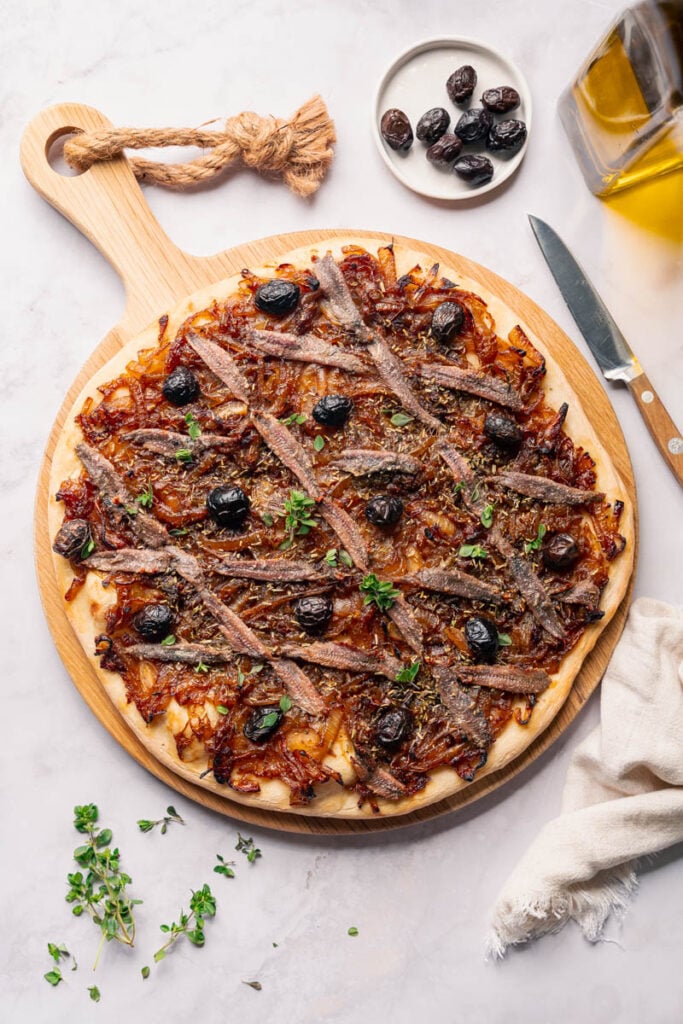
To stay fully in the spirit of the South, start the meal with a Pissaladière cut into small squares.

FAQ about Daube
Both are beef stews braised in red wine. But beef bourguignon has mushrooms and glazed pearl onions, while daube provençale gets orange peel, cloves and black olives.
In the traditional recipe, the beef marinates overnight in wine and herbs. I personally skip this step, and after five hours of cooking, I can’t taste any difference.
It comes down to either cooking time or temperature: either the beef hasn’t cooked long enough, or it boiled instead of simmering. Put it back in the oven, lid on, for another hour at 300 °F (150 °C), or 265 °F (130 °C) convection.
Yes! Sear the beef in a skillet first, deglaze with a splash of wine, then transfer everything to the slow cooker and cook on low for 8 to 9 hours. Since there’s hardly any evaporation, use a little less wine, or reduce the sauce in a pan at the end so it thickens.
If you can’t find Nyons olives, look for whole, well-wrinkled black olives. The wrinkles are a sign they were picked ripe from the tree. Perfectly smooth, round ones are actually dyed green olives and have much less flavor. Kalamata olives are also a great choice, and you’ll find them in almost any grocery store.
Yes, you can. Your daube will be lighter in color and a little fresher, less rich in flavor. Use a dry, full-bodied white like a white Côtes-du-Rhône or a Viognier, and avoid anything too acidic. Orange peel, cloves and olives go just as well with it.
More recipes for slow-cooked dishes
You Might Also Like...


You Might Also Like...
10 Comments

Absolutely amazing recipe! Put it in the oven in the morning and had an amazing dinner. We did have to leave it for 6h
Thank you so much, Catalina! Good to know that you did a little longer 🙂
Made it for 10 people and it was delicious! Takes more than 20 minutes preparation though. Cooking time in the oven is exact as indicated.
Thank you so much David 🙂
Best. Stew. Ever. We love it. It will become one of my favourite dishes.
Thank you so much, Zuzana!
Geraldine,
Te acompanho há alguns anos. Adoro suas receitas, já fiz várias. Farei esta e vou te mandar a foto. Gratidão pela inspiração!!
Thank you so much for following along all these years! Can’t wait to see your photo 🤍
Excellent recipe. Will definitely cook it soon.
You food does not only look good, but also always tastes delicious. Thank you!
Thank you so much, Karin! Let me know when you try it 🤗
Leave a Comment / Rate this recipe
French Provencal Beef Stew (Daube)