
 EN
 DE
 FR
French Braised Beef Cheeks in Red Wine


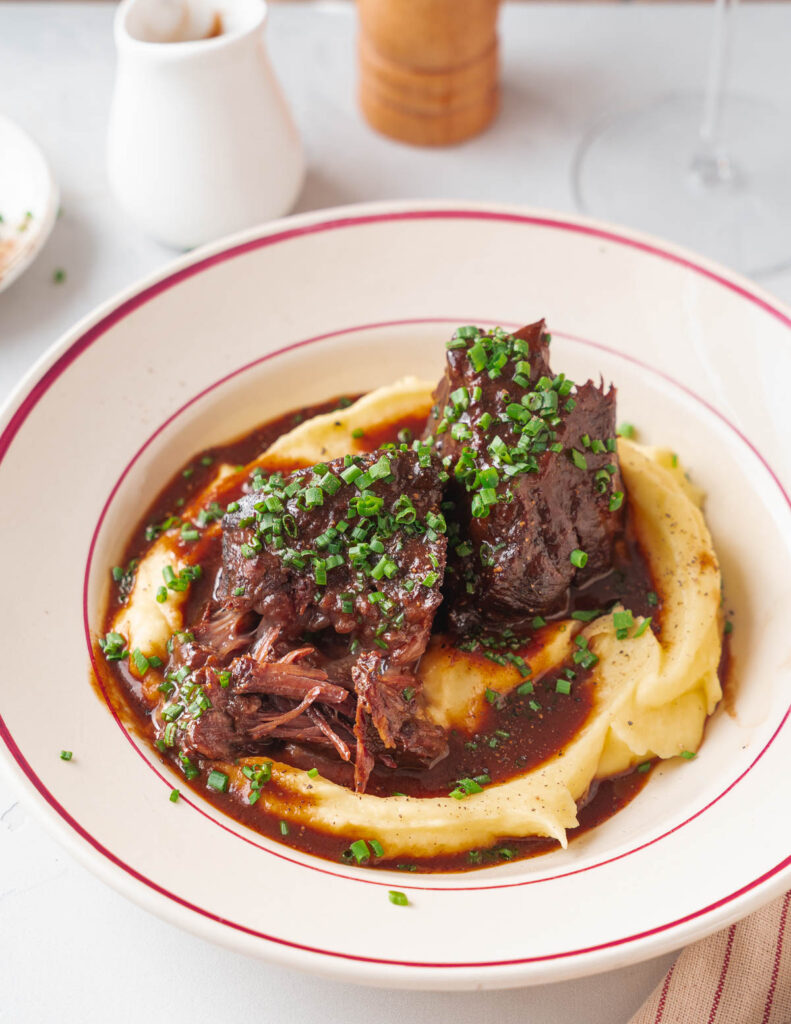
These braised beef cheeks in red wine are what I cook in winter when friends come over: 4 to 5 hours in a low oven, nothing to do while they braise, and meat so tender it falls apart under a spoon, in a glossy, intense sauce.
Jump to
If you’ve never tried beef cheeks before, you’ll see: it’s one of those ultra-tender cuts of meat that falls apart on your plate with just a fork. And when you let it cook for a long time over low heat in red wine, you get an incredibly flavorful, intense sauce that thickens naturally.
This is the perfect dish to make if you want to impress your first date or if you’re having friends over and are worried about ending up with dry meat—with beef cheeks braised in red wine, you can’t go wrong!

What Are Beef Cheeks, Exactly? (And Where to Buy Them)
Beef cheek, as the name suggests, is simply the jaw muscle. There are only two per animal, each weighing 1 ⅓ to 1 ¾ lb (600 to 800 g). It is a relatively inexpensive cut of meat.
You can serve it as a steak, but I find it tends to be pretty tough. So, personally, my favorite way to serve it is in a stew, like this one, or in a beef bourguignon, a Provençal stew, or a pot-au-feu.
My Tip
Your butcher may not always have beef cheeks on hand, since fewer and fewer people cook this cut these days. Call 2 or 3 days ahead to order them, and ask your butcher to trim them for you, which means removing the silverskin that doesn’t really melt during cooking.
Many US supermarkets don’t have beef cheeks, but usually you can order them at the butcher counter, and you’ll often find them at Latin markets, where they’re used for barbacoa. They cost about the same as chuck roast, a fraction of the price of a good steak.


My Tips for Fall-Apart Braised Beef Cheeks
If you had to read just three things before starting the recipe, these would be them:
- Sear them one at a time. This is the basis of the recipe—you need to sear the beef cheeks well on both sides to get a nice caramelization. That’s what will give your sauce its flavor later on!
- A parchment lid (cartouche), not a pot lid. A cartouche is simply a circle of parchment paper with a small hole in the center, laid directly on the meat: it keeps the beef cheeks from drying out while letting the sauce reduce and concentrate in flavor. Cut it to the size of your Dutch oven.
- Cook it gently and slowly. That’s the most important thing: your meat should cook over low heat, and the sauce should never come to a boil—otherwise, the fibers will tighten up and the meat will become tough.
- Prepare it the day before. Like all slow-cooked dishes in sauce, braised beef cheek always tastes better when reheated. It will have absorbed the flavors of the sauce and will be even more tender.


How to Cook Beef Cheeks: My Red Wine Braise Recipe
French Braised Beef Cheeks in Red Wine

Kitchen equipment
Ingredients
- 3 beef cheeks trimmed and left whole, 1 ⅓ to 1 ¾ lb each
- 2 tbsp neutral oil
- 2 carrots diced
- 2 stalks celery diced
- 1 large onion diced
- 4 garlic cloves unpeeled, crushed with the palm of your hand
- 2 tbsp tomato paste
- 2 tbsp all-purpose flour
- 2 ½ cups red wine a Côtes du Rhône, a Syrah/Grenache blend or Pinot Noir
- 1 ¼ cups beef stock
- 3 sprigs thyme 2 sprigs of rosemary, and 2 bay leaves, tied together to form a bouquet garni
- Salt and pepper
For the sauce and for serving
- 2 tbsp butter
- 2 tbsp chives chopped
Instructions
Preparation
- Preheat the oven to 300 °F (150 °C) conventional or 265 °F (130 °C) convection. Carefully pat the cheeks dry with paper towels and season them with salt on both sides. Leave them whole.

- In a cast-iron pot, heat the oil over high heat and sear the cheeks one at a time, 4 to 5 minutes per side, until they are deeply caramelized. Cook them one at a time: if you cook two at once, they’ll release their juices and boil instead of browning. Set them aside as you go.
- Reduce the heat to medium and sauté the carrots, celery, and onion for 6 minutes, until the onion is translucent. Add the unpeeled garlic cloves and the tomato paste, stir, and cook for 2 minutes.
- Return the beef cheeks to the pot, sprinkle with flour, stir to coat evenly, and cook for 1 minute.
- Deglaze with the red wine, scraping the bottom of the pot with a spatula to loosen all the browned bits, then add enough beef stock to almost cover the meat, along with the bouquet garni.
- Then place a sheet of parchment paper directly in contact with the liquid.


Braise
- Braise in the oven for 4 to 5 hours. After 20 minutes, lift the parchment lid and check that the sauce is barely simmering around the edges, never boiling. If it bubbles, turn the oven down a little; if it isn’t simmering at all, turn it up slightly.
- Alternative cooking method: Simmer very gently for 3 to 4 hours. Again, the sauce should never bubble vigorously.
- The beef cheeks are ready when a spoon slides into the meat without any resistance. If they’re still tough, give them another 30 minutes.

Serve
- Remove the cheeks from the pot and cut them into 3 or 4 pieces. Strain the sauce through a fine-mesh strainer to separate the liquid from the solids.
- Pour the sauce into a saucepan and let it reduce over high heat until it thickens naturally. Lower the heat, add the cubes of cold butter, and whisk well to incorporate them. Taste, and add salt and pepper if needed.
- If the cheeks have cooled, return them to the sauce to warm them up. Serve two pieces per person on a bed of mashed potatoes, with a twist of the pepper mill and a little chives.


Video
Notes
- Storage: Refrigerate in an airtight container for up to 3 days.
- Freezing: Freeze the meat and sauce together for up to 3 months. Thaw overnight in the refrigerator.
- Reheating: Warm gently in the sauce over very low heat, or in a 275°F oven for 30 minutes. Don’t let it boil, or the meat will fall apart.
Nutrition facts
How Long to Cook Beef Cheeks (Time and Oven Temperature)
I might as well tell you right away, this isn’t a quick recipe, but you really don’t need to keep an eye on it, so you can do other things while it’s cooking. However, if you want to make it and eat it the same day, I always recommend allowing a few extra hours and reheating it when the time comes.
For this recipe, allow at least 4 hours at 300 °F (150 °C) conventional, or 265 °F (130 °C) convection, and up to 5 hours depending on your Dutch oven and the meat itself. And if your meat is still tough after 4 hours, keep cooking it. It may seem counterintuitive, but that’s how it is with braised meat: the longer it cooks, the more tender it will be.
Why so long?
Collagen starts to break down once the inside of the meat reaches 158°F, but it takes time to turn into gelatin. If you turn up the heat, the fibers tighten and the meat dries out, even sitting in the sauce.

How to Get a Smooth, Glossy Red Wine Sauce
So, this is the only step that’s a little technical, but it’s definitely worth it to impress people!
- Strain. Remove the meat and strain the sauce through a fine-mesh strainer to remove the vegetables.
- Reduce. Pour the sauce into a saucepan and let it reduce over medium-high heat until it is reduced by 30 to 50 percent.
- Whisk in the butter. Once the sauce has reduced, lower the heat, add cubes of cold butter, and whisk to thicken the sauce.
It’s simple, but it’s a chef’s trick for making a beautiful, thick sauce with an intense flavor.

What Red Wine to Use for Braised Beef Cheeks
It all depends on what you want to use it for: when cooking, I like to choose a red wine that’s a bit full-bodied but not too much, with low tannins—like a Côtes-du-Rhône or a Languedoc made from Syrah and Grenache. You could also go with a Burgundy—the classic choice. There’s no need to spend too much on wine for cooking. My rule: cook with a wine you’d drink, but not the bottle you’ll serve.
To serve with this, I recommend a wine from the same region, but one that’s a little more complex: a nice Burgundy, a Madiran, or a Corbières.

What to Serve with Braised Beef Cheeks
In this case, you really need a side dish to mop up the sauce:
- Buttery mashed potatoes —a classic in my house—or celeriac purée for a lighter version;
- creamy polenta with Parmesan;
- wide fresh pasta, such as tagliatelle or pappardelle, for a more Italian touch;
- Rosemary-roasted potatoes, for a crispy contrast, or even duchesse potatoes for an even more elegant version.
And if you like dishes simmered in red wine, check out my traditional beef bourguignon—this recipe’s “big brother.”
Beef Cheeks FAQ
Beef cheek is simply the muscle from the cow’s jaw, and chuck is the upper part of the shoulder. The cheek is almost fat-free but much more gelatinous. When cooked for a long time, it becomes more tender and the sauce becomes thicker, and I find that it even cooks a little faster than the chuck. The chuck, on the other hand, is more fibrous, has more chew, and is a little fattier, which adds flavor.
Allow at least 4 hours at 300 °F (150 °C) conventional or 265 °F (130 °C) convection, and up to 5 hours depending on your pot and the meat. It’s ready when a spoon slides into the meat without resistance. If it’s still tough, just keep cooking it.
This is by far the most common question, and the answer is almost always the same. Either it hasn’t cooked long enough; in that case, simply let it cook longer. Or it cooked at too high a heat, which is harder to fix. Lower the heat, let it rest, then keep braising gently until the meat comes apart easily.
I always figure on about one cheek for every 2 to 3 people—that is, about ½ to ⅔ lb (250 to 300 g) of raw meat per person—keeping in mind that it will lose weight during cooking.
Yes. Sear and deglaze as in the recipe first, then cook 8 hours on low in a slow cooker, or 50 to 60 minutes at high pressure in an Instant Pot. The meat will be tender but less melt-in-your-mouth, and the sauce will remain more liquid. That’s okay, but you’ll need to reduce it well at the end.
Yes, you can either make an alcohol-free version by replacing the wine with beef stock and a little red wine vinegar or balsamic vinegar to recreate the wine’s tangy flavor. Or, you can make the exact same recipe with beer, and you’ll end up with another classic: beef cheek braised in beer, a bit like a carbonnade.
Yes, you can definitely freeze the leftovers. Put them in the freezer, along with the sauce, in an airtight container. They’ll keep for up to 3 months. To thaw, leave the container in the fridge overnight and reheat over very low heat, without ever bringing it to a boil.
No, despite its appearance, beef cheek isn’t fatty. It’s rich in collagen, and that’s exactly what makes it so tender and gives you such a silky sauce.
And if you’ve tried this recipe, feel free to leave me a comment and a rating—it really helps me out.
More French Braises and Stews
You Might Also Like...


You Might Also Like...
4 Comments

Génial! Made this tonight. And it was delicious! Served with mousseline and a very nice French red. The most important trick here is to not rush it!ov and buy your meat at a butcher. If you spend 4,5h, don’t do it on bad quality meat.
Thank you so much, Véro! I’m so glad it worked well for you. Exactly, I’m happy you found a good quality meat at your butcher!
Sadly the print button does not work -it just redirects me to the recipe page
Thank you for letting me know, I will take care of it!
Leave a Comment / Rate this recipe
French Braised Beef Cheeks in Red Wine